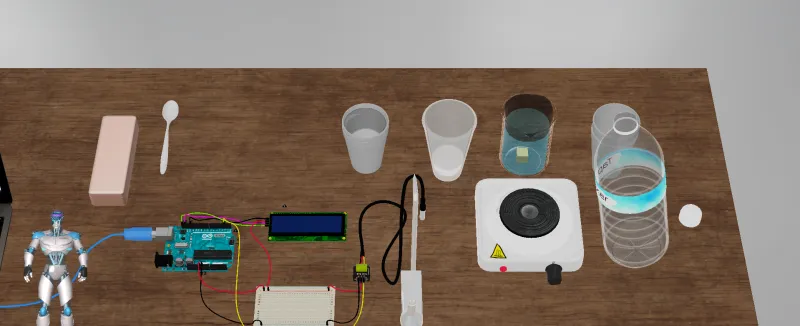
Calor Específico del Cobre
Calcula la capacidad calorífica específica del cobre.
Misión
Calcular la capacidad calorífica específica del cobre.
Alineación Curricular
| Estándar | Código del programa | Tema | Cobertura | Grados | |
|---|---|---|---|---|---|
| NGSS | HS-PS3-4 | Plan/conduct investigation providing evidence that thermal-energy transfer between components of different temperature yields a more uniform distribution (calorimetry) | Completa | 9–12 | |
| Británico / IGCSE | Specific heat capacity of copper — not IGCSE Chemistry syllabus content | Débil | 9–10 | ||
| IB | DP Chemistry Reactivity 1.1 | Measuring enthalpy changes — calorimetry technique (q=mcΔT) | Parcial | 11–12 | |
| CBSE | CBSE Class 11 Ch.6 – Thermodynamics (heat capacity, q=mcΔT) | Specific heat capacity of copper | Parcial | 11–11 | |
| AERO / AP | AP Unit 6 (Thermodynamics — heat capacity and calorimetry) | Specific heat capacity of copper | Completa | 11–12 |
Variables
Lo que cambias
- El líquido
Lo que mides
- Temperatura del líquido
Lo que mantienes constante
- Temperatura ambiente
- Volumen del líquido
- La cantidad de calor transferida
Ecuaciones
m_c = Mass of copper
C_c = Specific heat of copper
ΔT_c = Change in temperature for copper
m_w = Mass of water
C_w = Specific heat of water
ΔT_w = Change in temperature for water
T_i = Temperature of water at room temperature
T_f = Temperature of water and copper after stirring
m_c * C_c * ΔT_c = m_w * C_w * ΔT_w
(\frac{8.8}{1000}) Kg * C_c* (100-T_f) = (\frac{50}{1000}) Kg * 4200 (\frac{J}{Kg.K}) * (T_f - T_i)
Lo Que Necesitarás
- Protoboard de 400 puntos
- Arduino Uno
- Pantalla LCD I2C
- Sensor de temperatura sumergible (sonda de acero inoxidable)
Tiempo Estimado
Dato Sorprendente
Solo burbujeando.
Se utiliza un vaso de poliestireno expandido porque reduce el intercambio de calor entre el vaso y el aire. El material contiene pequeñas burbujas de aire que actúan como aislante, ya que el calor no puede viajar eficazmente a través de ellas. Esto también convierte al poliestireno en un gran amortiguador, pues las burbujas de aire absorben la fuerza del impacto.