Physics
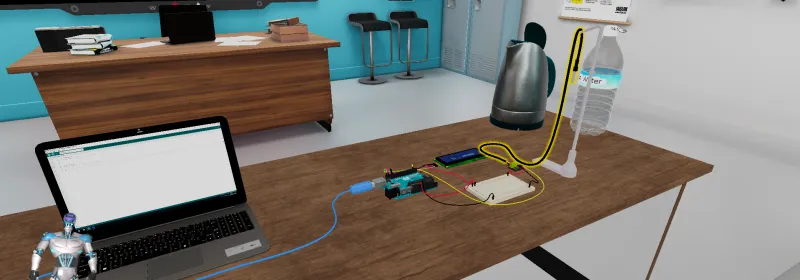
Determine specific heat of distilled water
Investigate the specific heat capacity of Water.
Mission
Investigate the specific heat capacity of Water.
Curriculum Alignment
| Standard | Syllabus code | Topic | Coverage | Grades | |
|---|---|---|---|---|---|
| NGSS | HS-PS3-4 | Plan/conduct investigation providing evidence that thermal-energy transfer between components of different temperature yields a more uniform distribution (calorimetry) | Full | 9–12 | |
| British / IGCSE | Specific heat capacity of water — not IGCSE Chemistry syllabus content | Weak | 9–10 | ||
| IB | DP Chemistry Reactivity 1.1 | Measuring enthalpy changes — calorimetry technique (q=mcΔT) | Partial | 11–12 | |
| CBSE | CBSE Class 11 Ch.6 – Thermodynamics (heat capacity, q=mcΔT) | Specific heat capacity of water | Partial | 11–11 | |
| AERO / AP | AP Unit 6 (Thermodynamics — heat capacity and calorimetry) | Specific heat capacity of water | Full | 11–12 |
Variables
What you change
- The Liquid
What you measure
- Liquid Temperature
What you keep constant
- Room Temperature
- Liquid Volume
- The Amount Of Heat Used
Equations
m_w = Mass of water
C_w = Specific heat of water
ΔT_w = Change in temperature for water
T_i = Temperature of water at room temperature
T_f = Temperature of water after heating
Q = Amount of heat
P = Power of kettle
t = Time of heating
Q = m_w * C_w * ΔT_w
P (watt) *t (s) = 1 Kg * C_w * (T_f - T_i)
What You'll Need
- Breadboard 400 Tie Point
- Arduino Uno
- I2C LCD
- Waterproof Temperature Sensor (Stainless Steel Probe)
Estimated Time
Virtual mode 16 minTest mode 23 minExercise mode 21 min
Mind-Blowing Fact
The ground cracks beneath.
The pressure of a woman's stiletto heel hitting the ground is great! It is greater than even venus' atmosphere.
How You Can Run It
Virtual modeTest modeExercise modeView-only modeAccessibility modeTobii eye trackingVoice commandsArduino integrationAmericanIB