Physics
Studying the effect of connecting batteries in series on final voltage output
Lemon batteries in series and final voltage.
Mission
Studying the effect of connecting lemon batteries in series on final voltage output
Curriculum Alignment
| Standard | Syllabus code | Topic | Coverage | Grades | |
|---|---|---|---|---|---|
| NGSS | No dedicated NGSS PE for galvanic/voltaic cells — closest adjacent is HS-PS3 energy DCIs | Weak | 9–12 | ||
| British / IGCSE | CAIE 0620 Topic 4 supplement — simple cells (two metals + electrolyte produce voltage) | Simple voltaic cells | Partial | 10–12 | |
| IB | DP Chemistry Reactivity 3.2 | Electron-transfer reactions — primary (voltaic) cells | Full | 11–12 | |
| CBSE | CBSE Class 12 Ch.2 – Electrochemistry (galvanic cells, EMF) | Galvanic cells, cells in series, EMF | Full | 12–12 | |
| AERO / AP | AP Unit 9 (Applications of Thermodynamics — galvanic/voltaic cells) | Voltaic cells, cell potential | Full | 11–12 |
Variables
What you change
- No. of lemons
What you measure
- Voltage Drop
What you keep constant
- Wire length
- Wire cross section
- Using copper and zinc
- All lemons are of the same kind
What You'll Need
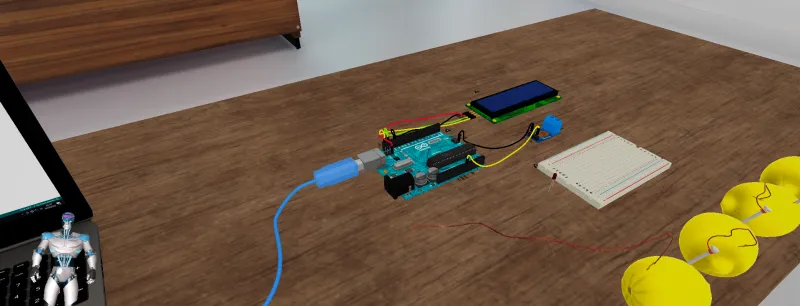
- Breadboard 400 Tie Point
- Arduino Uno
- I2C LCD
- 25V Voltage Sensor Module
- Red LED
Estimated Time
Virtual mode 9 minTest mode 13 minExercise mode 12 min
Mind-Blowing Fact
Thanks to the acid property of lemon juice, putting lemon juice on fish makes it taste and smell less "fishy". This is because the The acidity neutralizes amines, a chemical found in fish.
How You Can Run It
Virtual modeTest modeExercise modeView-only modeAccessibility modeTobii eye trackingVoice commandsAmericanIB