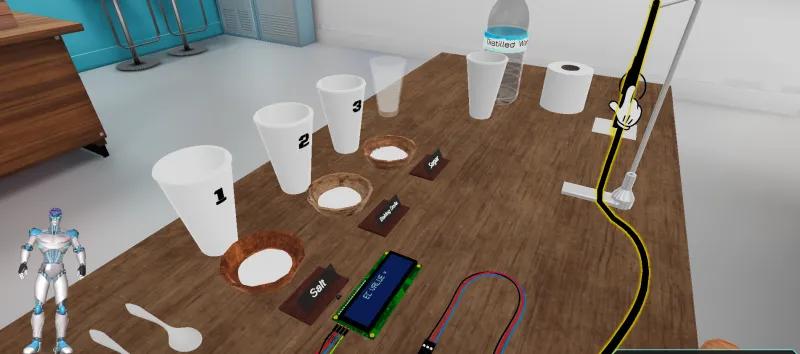
Electrical Conductivity of Solutions
Investigate the electrical conductivity of various substances dissolved in water.
Mission
Investigate the electrical conductivity of various substances dissolved in water
Curriculum Alignment
| Standard | Syllabus code | Topic | Coverage | Grades | |
|---|---|---|---|---|---|
| NGSS | HS-PS1-3 | Plan/conduct investigation comparing bulk-scale structure to electrical forces between particles (ionic vs covalent conductivity) | Full | 9–12 | |
| British / IGCSE | CAIE 0620 Topic 4 (Electrochemistry, §4.1 conductivity/electrolytes); cross-ref Topic 2 (ionic bonding) | Electrolytes vs non-electrolytes; ionic-compound conductivity | Full | 9–10 | |
| IB | DP Chemistry Structure 2.1 | Models of bonding and structure — ionic bonding and lattice conductivity | Full | 11–12 | |
| CBSE | CBSE Class 11 Ch.4 – Chemical Bonding and Molecular Structure | Ionic vs covalent bonding (theoretical) | Partial | 11–11 | |
| AERO / AP | AERO Grades 9-10 Physical Science — properties of matter / ionic structure (no AP unit tag on this lab) | Weak | 9–10 |
Variables
What you change
- Dissolved Solids
What you measure
- Electrical Conductivity
What you keep constant
- The Temperature
- Solution Volume
- Solution Concentration
What You'll Need
- Arduino Uno
- TDS Sensor
- I2C LCD
Estimated Time
Mind-Blowing Fact
Keep it pure.
The process of distilling water was described by Aristotle in the treatise Metorea. It is when the minerals of a body of water are removed by boiling the water. This process is done in order to remove the minerals from the water. Although this was done to "purify" the water, scientists today argue that many of the minerals found in water are vital for our health and therefore should not be done away with. On the other hand, non-distilled water (aka "hard" water) can cause issues in pipes and other infrastructures due to the build up of physical minerals blocking waterways.