Chemistry
Identify Non Electrolytes and Electrolytes
Investigate the electrical conductivity of various liquids.
Mission
Investigate the electrical conductivity of various liquids
Curriculum Alignment
| Standard | Syllabus code | Topic | Coverage | Grades | |
|---|---|---|---|---|---|
| NGSS | HS-PS1-3 | Bulk-scale structure vs electrical forces between particles (electrolyte identification) | Full | 9–12 | |
| British / IGCSE | CAIE 0620 Topic 4 (§4.1 conductivity/electrolytes) | Electrolytes vs non-electrolytes | Full | 9–10 | |
| IB | DP Chemistry Structure 2.1 | Models of bonding and structure — electrolyte conductivity | Full | 11–12 | |
| CBSE | CBSE Class 12 – Solutions (electrolyte vs non-electrolyte, van't Hoff factor) | Electrolyte vs non-electrolyte classification | Partial | 12–12 | |
| AERO / AP | AP Unit 3 (Intermolecular Forces and Properties) | Solutions and mixtures — electrolyte behavior | Full | 11–12 |
Variables
What you change
- Liquids
What you measure
- Electrical Conductivity
What you keep constant
- The Temperature
- Liquid Volume
- Liquid Concentration
What You'll Need
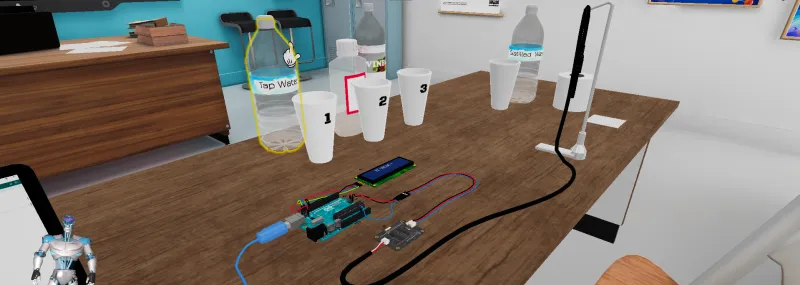
- Arduino Uno
- TDS Sensor
- I2C LCD
Estimated Time
Virtual mode 10 minTest mode 14 minExercise mode 13 min
Mind-Blowing Fact
Electricity. Grounded.
Did you know that if a bird stands on an electricity pole it will be perfectly unharmed? This is as the bird is not touching the ground and therefore cannot complete the electrical circuit - as no electricity can flow into the bird it remains safe. If, on the other hand, the bird comes in contact with another object - the circuit will be completed and electricity will flow through the bird.
How You Can Run It
Virtual modeTest modeExercise modeView-only modeAccessibility modeTobii eye trackingVoice commandsArduino integrationAmericanBritishIB