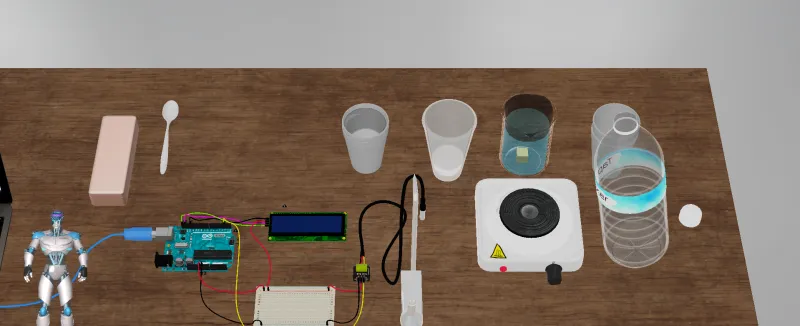
Specific Heat Of Copper
Calculate the specific heat capacity of Copper.
Mission
Calculate the specific heat capacity of Copper
Curriculum Alignment
| Standard | Syllabus code | Topic | Coverage | Grades | |
|---|---|---|---|---|---|
| NGSS | HS-PS3-4 | Plan/conduct investigation providing evidence that thermal-energy transfer between components of different temperature yields a more uniform distribution (calorimetry) | Full | 9–12 | |
| British / IGCSE | Specific heat capacity of copper — not IGCSE Chemistry syllabus content | Weak | 9–10 | ||
| IB | DP Chemistry Reactivity 1.1 | Measuring enthalpy changes — calorimetry technique (q=mcΔT) | Partial | 11–12 | |
| CBSE | CBSE Class 11 Ch.6 – Thermodynamics (heat capacity, q=mcΔT) | Specific heat capacity of copper | Partial | 11–11 | |
| AERO / AP | AP Unit 6 (Thermodynamics — heat capacity and calorimetry) | Specific heat capacity of copper | Full | 11–12 |
Variables
What you change
- The Liquid
What you measure
- Liquid Temperature
What you keep constant
- Room Temperature
- Liquid Volume
- The Amount Of Heat transfered
Equations
m_c = Mass of copper
C_c = Specific heat of copper
ΔT_c = Change in temperature for copper
m_w = Mass of water
C_w = Specific heat of water
ΔT_w = Change in temperature for water
T_i = Temperature of water at room temperature
T_f = Temperature of water and copper after stirring
m_c * C_c * ΔT_c = m_w * C_w * ΔT_w
(\frac{8.8}{1000}) Kg * C_c* (100-T_f) = (\frac{50}{1000}) Kg * 4200 (\frac{J}{Kg.K}) * (T_f - T_i)
What You'll Need
- Breadboard 400 Tie Point
- Arduino Uno
- I2C LCD
- Waterproof Temperature Sensor (Stainless Steel Probe)
Estimated Time
Mind-Blowing Fact
Just bubbling.
A styrofoam cup is used as it reduces the amount of heat exchange between the cup and the air. There are small air bubbles inside the material, meaning it is an insulator as heat energy cannot travel efficiently. This also makes styrofoam a great shock absorber as a result of the air bubbles bearing the force.