Physics
Specific Heat of Fluids
The relation between the nature of the fluid and its specific heat capacity.
Mission
The relation between the nature of the fluid and its specific heat capacity.
Curriculum Alignment
| Standard | Syllabus code | Topic | Coverage | Grades | |
|---|---|---|---|---|---|
| NGSS | HS-PS3-4 | Plan/conduct investigation providing evidence that thermal-energy transfer between components of different temperature yields a more uniform distribution (calorimetry) | Full | 9–12 | |
| British / IGCSE | Specific heat capacity of different fluids (vinegar, milk, water) — not IGCSE Chemistry syllabus content | Weak | 9–10 | ||
| IB | DP Chemistry Reactivity 1.1 | Measuring enthalpy changes — calorimetry technique (q=mcΔT) | Partial | 11–12 | |
| CBSE | CBSE Class 11 Ch.6 – Thermodynamics (heat capacity, q=mcΔT) | Specific heat capacity of different fluids (vinegar, milk, water) | Partial | 11–11 | |
| AERO / AP | AP Unit 6 (Thermodynamics — heat capacity and calorimetry) | Specific heat capacity of different fluids (vinegar, milk, water) | Full | 11–12 |
Variables
What you change
- The liquid
What you measure
- Liquid temperature
What you keep constant
- Room temperature
- Liquid volume
- The amount of energy used
Equations
m = Mass of vinegar / milk
C = Specific heat of vinegar / milk
ΔT = Change in temperature for vinegar / milk
T_i = Temperature of vinegar / milk at room temperature
T_f = Temperature of vinegar / milk after heating
Q = Amount of heat
P = Power of kettle
t = Time of heating
Q = m * C * ΔT
P (watt) * t (s) = 1 (kg) * C * (T_f - T_i)
What You'll Need
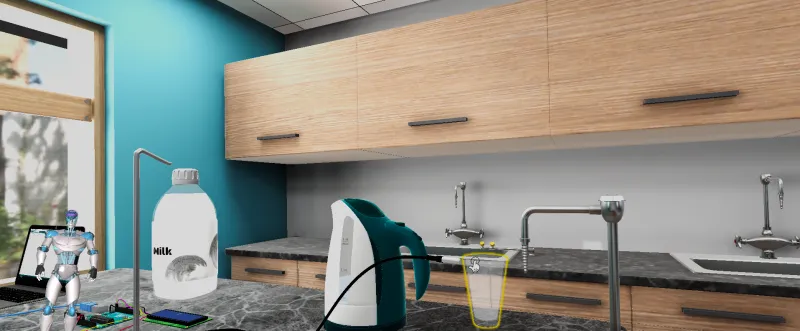
- Breadboard 400 Tie Point
- Arduino Uno
- I2C LCD
- Waterproof Temperature Sensor (Stainless Steel Probe)
Estimated Time
Virtual mode 14 minTest mode 20 minExercise mode 18 min
Mind-Blowing Fact
I'd like to see you try, though.
Some things have a negative heat capacity, for example, stars. If you were to apply heat energy to a star, it would cool down.
How You Can Run It
Virtual modeTest modeExercise modeView-only modeAccessibility modeTobii eye trackingVoice commandsArduino integrationAmericanIB