Physics
State of Matter
Investigate the changes of state between solids, liquids and gases.
Mission
Investigate the changes of state between solids, liquids and gases.
Curriculum Alignment
| Standard | Syllabus code | Topic | Coverage | Grades | |
|---|---|---|---|---|---|
| NGSS | MS-PS1-4 | Model predicting particle motion/temperature/state changes with thermal energy added/removed | Full | 6–8 | |
| British / IGCSE | CAIE 0620 Topic 1 (States of matter — melting/boiling points, kinetic particle theory) | Melting point, heating curve, states of matter | Full | 6–10 | |
| IB | MYP Sciences — states of matter (intro level; no dedicated DP topic at this depth) | Full | 9–10 | ||
| CBSE | CBSE Class 9 Ch.1 – Matter in Our Surroundings | States of matter, melting/boiling point, heating curve | Full | 9–9 | |
| AERO / AP | AERO Grades 6-8 Physical Science — states of matter | Partial | 6–8 |
Variables
What you change
- Time
What you measure
- Temperature
What you keep constant
- Speed of stirring
- Number and size of ice cubes
- Amount Of Heat Used
- Material and size of bowl
- Room temperature
What You'll Need
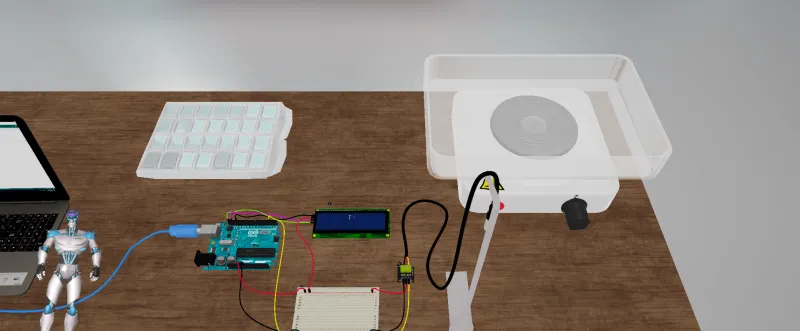
- Breadboard 400 Tie Point
- Arduino Uno
- I2C LCD
- Waterproof Temperature Sensor (Stainless Steel Probe)
Estimated Time
Virtual mode 14 minTest mode 21 minExercise mode 19 min
Mind-Blowing Fact
Why does it all Matter?
There are 4 states of matter that occur naturally - being: solid, liquid, gas and plasma. In addition to these states, there are actually 26 theorized states! An example is the Bose-Einstein condensate. This state is when seperate particles, cooled near absolute zero, become one singular unit.
How You Can Run It
Virtual modeExercise modeView-only modeAccessibility modeTobii eye trackingVoice commandsArduino integrationAmericanBritishIB