Física
Ley de Voltajes de Kirchhoff
Investiga la ley de voltajes de Kirchhoff.
Misión
Investigar la ley de voltajes de Kirchhoff.
Alineación Curricular
| Estándar | Código del programa | Tema | Cobertura | Grados | |
|---|---|---|---|---|---|
| NGSS | Parcial | 9–12 | |||
| Británico / IGCSE | 0625 §4.3.2(8b) | CAIE IGCSE Physics 0625 — 4.3.2 Supplement #8b (series p.d. sum) vs A-Level 9702 topic 10 D.C. circuits (named Kirchhoff's laws) | Parcial | 9–12 | |
| IB | DP B.5 | DP Physics — Theme B.5 Current and circuits (Kirchhoff's laws, circuit analysis) | Completa | 11–12 | |
| CBSE | Class 12 Ch 3 | CBSE/NCERT Class 12 Physics — Current Electricity (Kirchhoff's Current & Voltage Laws, explicit) | Completa | 12–12 | |
| AERO / AP | AP Physics 2 Unit 11.4 | AP Physics 2 — Unit 11.4 Kirchhoff's Loop Rule | Completa | 11–12 |
Variables
Lo que cambias
- Valor de la resistencia
Lo que mides
- Caída de voltaje
Lo que mantienes constante
- Longitud del alambre
- Sección transversal del alambre
- Valor del voltaje de la batería
- Temperatura del alambre
Ecuaciones
V_1 = Voltage drop on first resistor (V)
V_2 = Voltage drop on second resistor (V)
V_3 = Voltage drop on third resistor (V)
V_4 = Voltage drop on fourth resistor (V)
V_5 = Voltage drop on fifth resistor (V)
V_Bat ≈ 6 Volts
R_1, R_2, R_3, R_4, R_5 = Resistors (ohm)
V_Bat = V_1 + V_5
V_Bat = V_2 + V_3
V_Bat = V_2 + V_4 + V_5
Lo Que Necesitarás
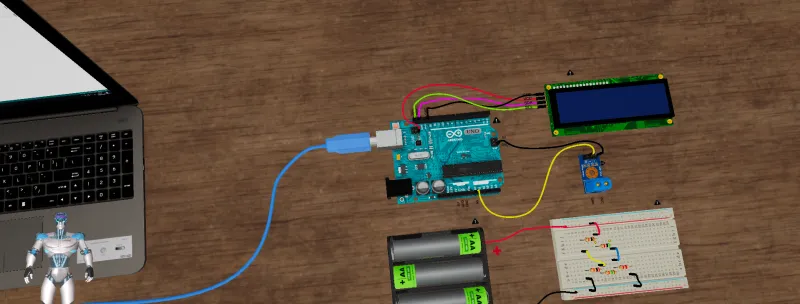
- Protoboard de 400 puntos
- Arduino Uno
- Pantalla LCD I2C
- Módulo sensor de voltaje 25V
- Pack de baterías 6V, 4x AA
- Resistencia
Tiempo Estimado
Modo virtual 9 minModo de prueba 13 minModo de ejercicio 12 min
Dato Sorprendente
Matemáticas al instante.
El método de multiplicación "por duplicación" fue creado por los antiguos egipcios, y les permitía multiplicar cualquier número usando solo la habilidad de duplicar, dividir entre dos y sumar. Este proceso todavía se utiliza en los circuitos multiplicadores binarios.
Cómo Puedes Realizarlo
Modo virtualModo de pruebaModo de ejercicioModo solo lecturaModo de accesibilidadSeguimiento ocular TobiiComandos de vozIntegración con ArduinoAmericanoBritánicoIB