Physics
Friction Force
Studying the effect of the surface material on friction coefficient.
Mission
Studying the effect of the surface material on friction coefficient
Curriculum Alignment
| Standard | Syllabus code | Topic | Coverage | Grades | |
|---|---|---|---|---|---|
| NGSS | Partial | 6–8 | |||
| British / IGCSE | 0625 §1.5.1 | CAIE IGCSE Physics 0625 — 1.5.1 Effects of forces (Core #6-8: friction qualitative — force impeding motion, drag, heating) | Partial | 9–10 | |
| IB | DP A.2 | DP Physics — Theme A.2 Forces and momentum (kinetic/static friction, coefficient μ, quantitative) | Full | 11–12 | |
| CBSE | Class 11 Laws of Motion | CBSE/NCERT Class 11 Physics — Laws of Motion (friction coefficient, inclined-plane problems) | Full | 11–11 | |
| AERO / AP | AP Physics 1 Unit 2 | AP Physics 1 — Unit 2 Dynamics (static/kinetic friction, μ, inclined planes) | Full | 11–12 |
Variables
What you change
- Surface Smoothness
What you measure
- Friction Coefficient
What you keep constant
- Sliding Object
- Inclination Angle
- Sliding Distance
Equations
d = Distance (0.5 m)
t = Time (s)
V = Velocity (\frac{m}{s})
G = Gravity (\frac{m}{s^2})
Θ = Inclination Angle (20)
μ = Friction Coefficient
μ = \frac{d*g*sin(Θ)-\frac{1}{2}*v^2}{d*g*cos(Θ)}
What You'll Need
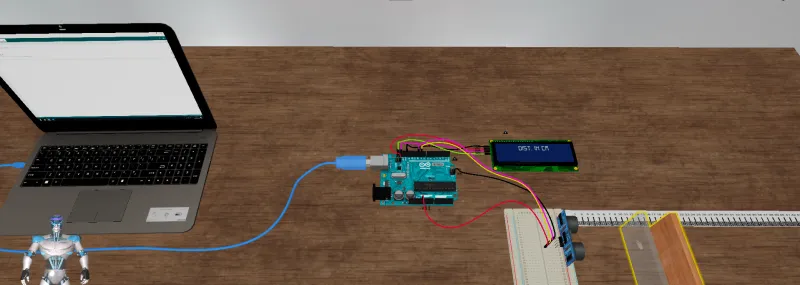
- Breadboard 400 Tie Point
- Arduino Uno
- I2C LCD
- IR Sensor
Estimated Time
Virtual mode 11 minTest mode 16 minExercise mode 15 min
Mind-Blowing Fact
American Fortitude.
The Washington Monument has no mortar. Only blocks which have been held together by just gravity and friction.
How You Can Run It
Virtual modeTest modeExercise modeView-only modeAccessibility modeTobii eye trackingVoice commandsArduino integrationAmericanBritishIB