Virtual labs and hands-on kits, together
Virtual or hands-on? With Labs For Home, the answer is both.
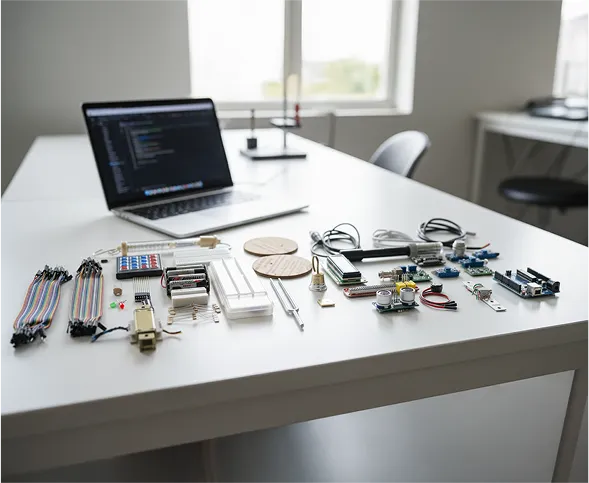
Virtual or hands-on? Both.
Virtual labs give every student a safe, repeatable experiment they can run anywhere, with no consumables to restock. Hands-on kits give students real sensors, real measurements and the experience of building the circuit themselves. Neither replaces the other — used together, they cover what either one alone misses.
Virtual Labs
- Safe and repeatable — no hazardous reagents, no breakage
- Every student gets their own experiment, anywhere with a browser
- No consumables to restock between classes
- Curriculum-aligned experiments across physics, chemistry and biology
 Explore Virtual Labs
Hands-On Kits
- Real sensors and real measurements, not a simulation
- Students build the circuit and see it work
- Arduino-based hardware that expands as your curriculum grows
- The kit's experiments also run as virtual labs, so students can prepare or review either way
Explore Physical KitsOne class, both tools
- 1
Prepare
Students rehearse the experiment virtually first, so class time starts with a working understanding of the steps.
- 2
Build
Students run the same experiment with the physical kit — real sensors, real wiring, real measurements.
- 3
Review
Students revisit the experiment virtually afterward to repeat it, compare results or catch up if they missed class.
Are virtual labs effective?
Virtual labs work best alongside hands-on practice, not as a replacement for it — that is the point of this page. Used on their own, they give every student safe, repeatable access to an experiment. Paired with a hands-on kit, students also get the physical skills — wiring, measurement, troubleshooting — that a simulation cannot teach. Blended learning, virtual and hands-on together, is how Labs For Home is meant to be used.
What's inside each side
The software
Beyond the experiment itself, students get coding practice in C and Python, difficulty that adapts to each learner, an accessibility system with eye-tracking and voice-command support, and MindUP!, a general-knowledge layer that rewards curiosity outside the lab.
The kit
The hardware covers heat-and-environment sensors, chemistry-and-fluid sensors, electrical-and-magnetic sensors, light-and-sound sensors, and medical-and-bio sensors, plus the controllers, connections and lab equipment needed to wire an experiment together by hand.
How much overlap is there?
Nearly every one of the 55+ experiments in the virtual lab library also ships with a physical kit version, so most of what a class runs virtually can be rebuilt with real hardware later. The rest stay virtual-only.
How buying works
The software and the physical kit are sold separately, and either one can be bought on its own. Start with the virtual labs software, start with the hands-on kit, or get both — you can always add the other product later.