Chemistry
Neutralization Reaction
Investigating neutralization reactions.
Mission
Investigating neutralization reactions.
Curriculum Alignment
| Standard | Syllabus code | Topic | Coverage | Grades | |
|---|---|---|---|---|---|
| NGSS | HS-PS1-11 | Investigate acid/base properties and behaviors — pH, neutralization capability, conductivity, titrations | Full | 9–12 | |
| British / IGCSE | CAIE 0620 Topic 7 (Acids, bases and salts) | Neutralization reactions, pH scale | Full | 9–12 | |
| IB | DP Chemistry Reactivity 3.1 | Proton-transfer reactions — acid-base neutralization, pH curves | Full | 11–12 | |
| CBSE | CBSE Class 10 Ch.2 – Acids, Bases and Salts | Neutralization reactions | Full | 10–10 | |
| AERO / AP | AP Unit 8 (Acids and Bases) | Acid-base reactions, neutralization | Full | 11–12 |
Variables
What you change
- Volume of vinegar added
What you measure
- pH Value
What you keep constant
- The Temperature
- Vinegar concentration
- Baking soda solution concentration
- Baking soda solution volume
What You'll Need
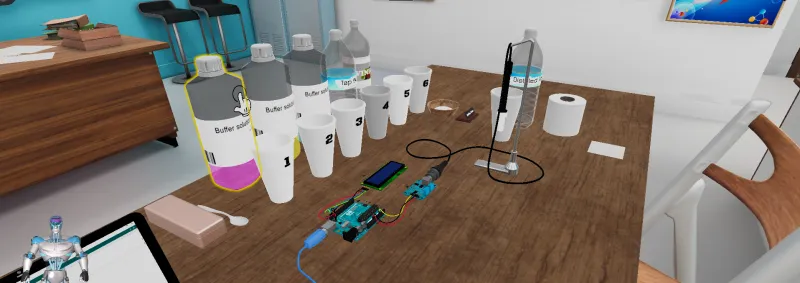
- Arduino Uno
- pH Sensor Electrode Probe BNC
- I2C LCD
Estimated Time
Virtual mode 16 minTest mode 23 minExercise mode 21 min
Mind-Blowing Fact
Drunk Science.
In 1909, the pH scale was invented by scientist and skilled brewer Søren Sørensen while experimenting with beer. In the search for the perfect pint, he explored the enzymes made from proteins and quickly realized that hydrogen ion concentrations were important to how these enzymes performed their functions. He developed the pH scale as a way to keep track of these conditions in a solution. The H in pH means hydrogen. The p is unknown, as he never did say what it meant, but it is speculated that it means power. Thus, pH means "Power of Hydrogen".
How You Can Run It
Virtual modeTest modeExercise modeView-only modeAccessibility modeTobii eye trackingVoice commandsArduino integrationAmericanBritishIB