Chemistry
Ionic Vs Covalent bonds
Investigate the types of bonds for different liquids.
Mission
Investigate the types of bonds for different liquids
Curriculum Alignment
| Standard | Syllabus code | Topic | Coverage | Grades | |
|---|---|---|---|---|---|
| NGSS | HS-PS1-3 | Bulk-scale structure vs electrical forces between particles (ionic vs covalent conductivity) | Full | 9–12 | |
| British / IGCSE | CAIE 0620 Topic 4 (§4.1 conductivity as ionic/covalent classifier); cross-ref Topic 2 (ionic/covalent bonding) | Distinguishing ionic and covalent compounds by conductivity | Full | 9–12 | |
| IB | DP Chemistry Structure 2.1 | Models of bonding and structure — ionic vs covalent bonding | Full | 11–12 | |
| CBSE | CBSE Class 11 Ch.4 – Chemical Bonding and Molecular Structure | Ionic vs covalent bonding (theoretical) | Partial | 11–11 | |
| AERO / AP | AP Unit 2 (Compounds and Molecular Structure) | Ionic vs covalent bonding, bond energy | Full | 11–12 |
Variables
What you change
- Liquids
What you measure
- Electrical Conductivity
What you keep constant
- The Temperature
- Liquid Volume
- Liquid Concentration
What You'll Need
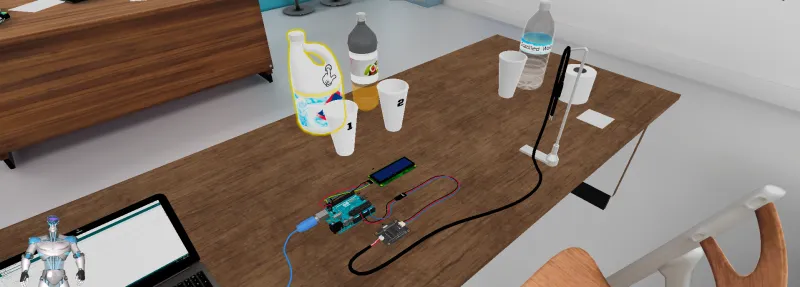
- Arduino Uno
- TDS Sensor
- I2C LCD
Estimated Time
Virtual mode 10 minTest mode 14 minExercise mode 13 min
Mind-Blowing Fact
Clean em' up.
Bleach is often used as a way in order to remove stains from clothes. This is because it reacts with the colored compound and breaks them down. In bleach the active ingredient, sodium hypochlorite, denatures protein in micro-organisms and can thus also be considered effective in killing bacteria, fungus and viruses.
How You Can Run It
Virtual modeTest modeExercise modeView-only modeAccessibility modeTobii eye trackingVoice commandsArduino integrationAmericanBritish