Physics
Kirchhoff's Voltage Law
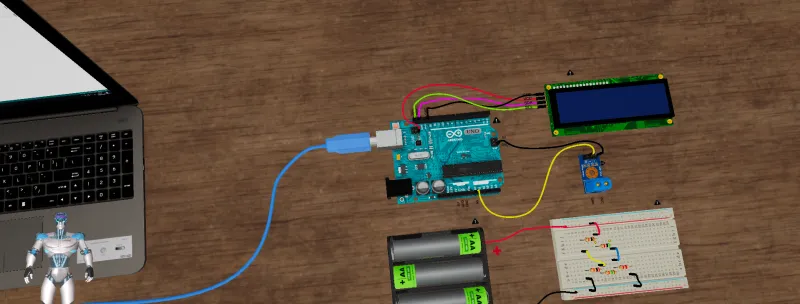
Investigate Kirchhoff's voltage law.
Mission
Investigate Kirchhoff's voltage law
Curriculum Alignment
| Standard | Syllabus code | Topic | Coverage | Grades | |
|---|---|---|---|---|---|
| NGSS | Partial | 9–12 | |||
| British / IGCSE | 0625 §4.3.2(8b) | CAIE IGCSE Physics 0625 — 4.3.2 Supplement #8b (series p.d. sum) vs A-Level 9702 topic 10 D.C. circuits (named Kirchhoff's laws) | Partial | 9–12 | |
| IB | DP B.5 | DP Physics — Theme B.5 Current and circuits (Kirchhoff's laws, circuit analysis) | Full | 11–12 | |
| CBSE | Class 12 Ch 3 | CBSE/NCERT Class 12 Physics — Current Electricity (Kirchhoff's Current & Voltage Laws, explicit) | Full | 12–12 | |
| AERO / AP | AP Physics 2 Unit 11.4 | AP Physics 2 — Unit 11.4 Kirchhoff's Loop Rule | Full | 11–12 |
Variables
What you change
- Resistance value
What you measure
- Voltage Drop
What you keep constant
- Wire length
- Wire cross section
- Battery voltage value
- Temperature of wire
Equations
V_1 = Voltage drop on first resistor (V)
V_2 = Voltage drop on second resistor (V)
V_3 = Voltage drop on third resistor (V)
V_4 = Voltage drop on fourth resistor (V)
V_5 = Voltage drop on fifth resistor (V)
V_Bat ≈ 6 Volts
R_1, R_2, R_3, R_4, R_5 = Resistors (ohm)
V_Bat = V_1 + V_5
V_Bat = V_2 + V_3
V_Bat = V_2 + V_4 + V_5
What You'll Need
- Breadboard 400 Tie Point
- Arduino Uno
- I2C LCD
- 25V Voltage Sensor Module
- 6V Battery Pack, 4x AA
- Resistor
Estimated Time
Virtual mode 9 minTest mode 13 minExercise mode 12 min
Mind-Blowing Fact
Quick maths.
The multiplication method "doubling" was a method made by the ancient Egyptians that allowed them to multiply any number using the skill of multiplying by two, dividing by two and how to add two numbers. This process is still in use in binary multiplier circuits.
How You Can Run It
Virtual modeTest modeExercise modeView-only modeAccessibility modeTobii eye trackingVoice commandsArduino integrationAmericanBritishIB