Physics
Voltage in resistors connected in parallel
The effect of adding resistors in parallel on the voltage.
Mission
The effect of adding resistors in parallel on the voltage.
Curriculum Alignment
| Standard | Syllabus code | Topic | Coverage | Grades | |
|---|---|---|---|---|---|
| NGSS | HS-PS3-6 | HS-PS3-6 (Ohm's law; potential difference in series/parallel circuits) | Full | 9–12 | |
| British / IGCSE | 0625 §4.3.2 | CAIE IGCSE Physics 0625 — 4.3.2 Supplement #8c: p.d. across parallel arrangement = p.d. across one branch | Full | 9–10 | |
| IB | DP B.5 | DP Physics — Theme B.5 Current and circuits | Full | 11–12 | |
| CBSE | Class 10 Ch 12 | CBSE/NCERT Class 10 Science — Ch 12 Electricity (voltage in parallel branches) | Full | 10–10 | |
| AERO / AP | AERO Science | AERO K-10 Science Framework — Physical Science: electric circuits (general strand, no numbered PE) | Full | 9–10 |
Variables
What you change
- Battery Voltage
What you measure
- Voltage Drop
What you keep constant
- Wire length
- Wire cross section
- Temperature of wire
Equations
V_1 = Voltage drop on first resistor (V)
V_2 = Voltage drop on second resistor (V)
V_3 = Voltage drop on third resistor (V)
V_Bat ≈ 6 Volts
R_1, R_2, R_3 = Resistors (ohm)
V_1=V_2=V_3=V_Bat
What You'll Need
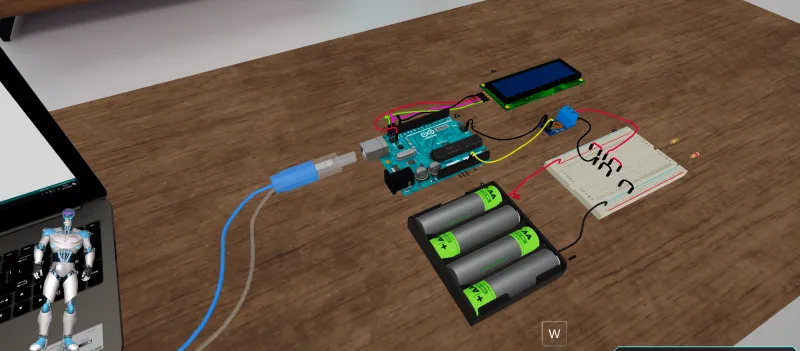
- Breadboard 400 Tie Point
- Arduino Uno
- I2C LCD
- 25V Voltage Sensor Module
- Resistor
- 6V Battery Pack, 4x AA
Estimated Time
Virtual mode 8 minTest mode 11 minExercise mode 10 min
Mind-Blowing Fact
Pile of electricity.
The volt is named for Alessandro Volta because his voltaic pile was the beginning of the battery — and for decades it was the best way to reliably provide electricity. The term became standard at the International Electrical Congress of 1881.
How You Can Run It
Virtual modeTest modeExercise modeView-only modeAccessibility modeTobii eye trackingVoice commandsArduino integrationAmericanBritishIB